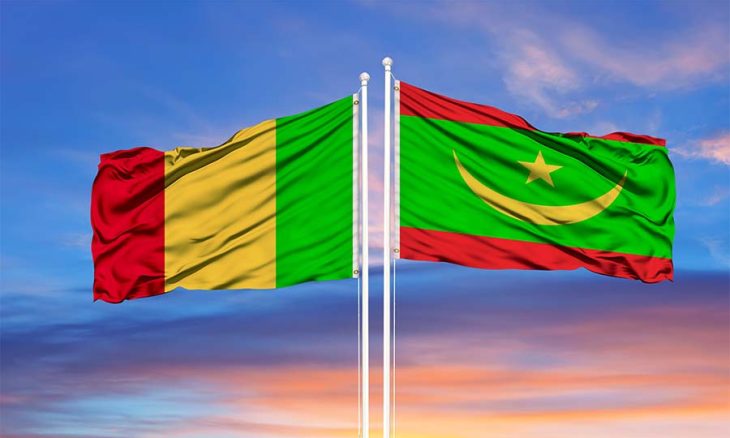
Regrettably, corruption and strategic miscalculation were among the foremost causes of the stalled border demarcation between Mauritania and Mali.
Massive investments were squandered on fictitious projects during the 1990s and even before the emergence of the East-West struggle for influence in Mali, whereas those resources would have been sufficient to resolve this long-standing dilemma.
Algeria recognized this reality early on. When it sought to definitively settle the demarcation of its border with Mali, it provided the technical and financial means required to assist the Malian side; the border was officially demarcated in 1983, and the file was closed peacefully.
As for us, we have missed the decisive moment, and there is now an urgent need to rectify the situation. As American General Douglas MacArthur once said:
"All major defeats can be summed up in one word: too late."
He added in his military philosophy:
"Battle does not merely mean the use of weapons in the classical sense, but encompasses all tools of power, including soft power."
Here, we must realize that border demarcation is an overarching battle, unmatched by any other.
The border between Mauritania and Mali extends for approximately 2,237 km. Deducting the Karakoro riverbed, estimated at around 124 km, leaves the actual distance to be demarcated at about 2,213 km.
The cost of demarcating each kilometer is estimated at roughly $230,000, according to international precedent and World Bank studies, meaning that the total cost could reach around 500 million US dollars.
Nonetheless, the solution does not lie merely in figures and calculations. For among humanity's greatest shortcomings—as the poet Abu al-Tayyib al-Mutanabbi observed:
"Nor have I seen among people's faults anything *** like the falling short of those capable of completion."
We must move beyond merely offering excuses and lamenting lost opportunities. "Entangling" or compromising the Malian side does not serve our national security; rather, it could lead to grave repercussions stemming from border chaos, threatening our stability as a people and as a state.
The alternative is to build a solid relationship with Mali—one that helps spare the Malian people from ongoing bloodshed and rescues the state from collapse, by leveraging the soft power we possess—historical, cultural, and geopolitical—which is capable of restoring balance to the region.
Here, we must emphasize that rescuing Mali should be channeled into the border demarcation project, far from the climate of tension and polarization it suffers today, because this strategic choice safeguards our security and regional stability while reinforcing our proactive presence in our geographic neighborhood.
On the issue of the Malian border, it is striking that the Mauritanian expatriate community in Mali does not vote in elections, unlike in Senegal, Côte d'Ivoire, and elsewhere, while voting was taking place, unlawfully, in Malian border villages, inside Mauritanian polling stations and schools outside Mauritanian territory, driven by the influence of local political figures in rural areas.
The Independent National Electoral Commission has recently removed several of these stations, including a voting center in a village stormed by the Malian army accompanied by Russian Wagner forces.
In conclusion, I promise to dedicate a full episode of my program "Spying on the Future," which I prepare, present, and broadcast on the Attayar platform, to analyzing the soft power Mauritania possesses and how it can be leveraged as an effective strategic instrument to address the Mauritanian-Malian crisis and protect the security and stability of our region.
Ahmed Mbareck
President of the Deyloul Center for Strategic Studies