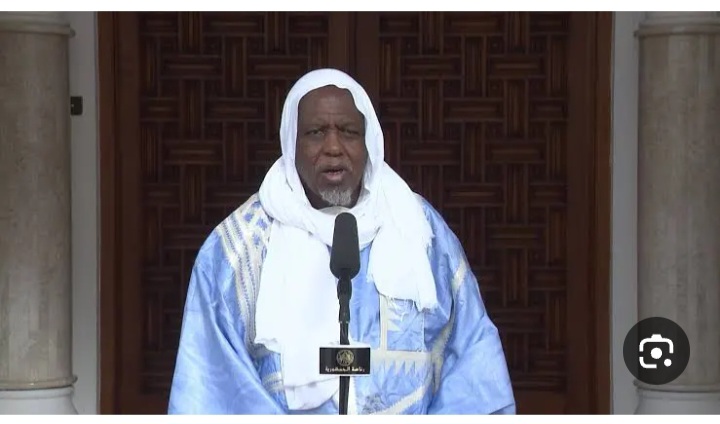
The Imam Who Topples Presidents… Will He Prevent the State from Collapsing into Chaos?
--------
The name of "Mahmoud Dicko" is emerging as a middle ground that could save Mali from chaos.
The man mobilizes the street whenever he speaks; sermons at his mosque in the "Badalabougou" neighborhood ignited the first waves of protest in June 2020, before the popular movement expanded and toppled "Ibrahim Boubacar Keïta" on August 18, 2020.
This role earned him a widely circulated moniker in Bamako: "the imam who topples presidents."
Yet he has remained silent so far, leaving the country anxiously waiting for him to speak.
His personal attributes make him an acceptable and viable transitional figure across local, regional, and international circles:
1. His distant Fulani roots provide him with broad social reach within one of the largest demographic groups in central and northern Mali, making him credible to many Fulani who form the core forces of Katiba "Macina", thereby giving him an entry point to Mali's Fulani community.
2. His geographical proximity to Azawad, having been born in a village only a few kilometers from Timbuktu, grants him a profound understanding of the dynamics of influence in the North.
3. His doctrinal leaning toward Salafism, even as he is portrayed in Algeria—where he lives in silent exile—as a figure of the Qadiriyya Sufi order, demonstrates his ability to engage diverse, and even conflicting, religious traditions.
4. The trust he enjoys among moderate circles in Mali, who have called on the authorities to enlist his help in opening a dialogue channel with jihadist groups, recognizing his capacity to bridge spiritual authority with social and political capital.
The prevailing stalemate on the ground in Mali points to such a conclusion:
1. Katiba "Macina" advanced to the gates of the capital in recent weeks, then abruptly halted any major offensive, despite its proven ability to breach high-security installations.
2. It had previously struck the "Kati" military base, the president's residence, at dawn on July 22, 2022, with twin car-bomb attacks that sent shockwaves across the country.
3. It struck again inside the capital on September 17, 2024, targeting the Modibo Keïta International Airport and the gendarmerie base in "Faladié" in a coordinated attack that threw security services into disarray.
What keeps "Macina" from undertaking a similar move today?
What prevents it from intercepting supply and food trucks arriving from Mauritania, Senegal, and Côte d'Ivoire, while it halts operations against fuel tankers and recently threatened food transport trucks?
What leads it to watch the situation unfold without resuming major operations, despite possessing the capability to do so?
The most plausible explanation is the presence of an active communication channel, indirect negotiations, or preliminary understandings aimed at averting an explosion until the contours of the next phase become clear.
Meanwhile, the "Iyad Ag Ghaly" option recedes entirely when reviewing his history with Azawad leaders.
The events of 2012 reveal that Azawad leaders refused to endorse him as a leader, keeping him outside the decision-making circle and driving him toward radicalism, far from any unifying role, by founding "Ansar Dine" in 2012, which later merged with other groups to form the Group for the Support of Islam and Muslims (JNIM), whose operations rely primarily on Katiba Macina.
The question remains: will the current moment permit the return of "Mahmoud Dicko" to serve as the bridge leading Mali out of chaos?
Warm regards,
Ahmedou M'barek